According to Article 121.1 of the Patent Act, a “design” refers to a creation with visual appeal made in respect of the shape, pattern, color, or any combination thereof applied to all or part of an article. Article 53 of the Enforcement Rules of the Patent Act further stipulates that the drawings of a design shall include sufficient views to fully disclose the appearance of the claimed design; where the design is a continuous surface pattern, a pattern unit view shall be included. The term “views” may include a perspective view, front view, rear view, left-side view, right-side view, top view and bottom view, plan view, pattern unit view or other auxiliary views. Accordingly, a pattern unit view serves to illustrate the specific features of the repeating unit, so as to clearly and fully disclose the appearance of the applied-for design, enabling a person skilled in the art to understand how the surface pattern design is continuously extended and to implement it accordingly. However, the Patent Examination Guidelines contain no direct provisions regarding the correlation between pattern unit views and the patentability of continuous surface pattern designs.
The actual role a pattern unit view plays in evaluating the patentability of a continuous surface pattern design can be observed in a recent judgment rendered by the Intellectual Property and Commercial Court (hereinafter “the IP Court”). In this case, the design patentee (the “Plaintiff”) filed an administrative lawsuit challenging the invalidation decision made by the Intellectual Property Office (hereinafter “the IPO”) and the subsequent dismissal of its appeal by the Board of Appeals.
The patent at issue relates to a design for a “fabric” characterized by a fabric pattern produced through digital 3D printing. It primarily features two adjacent yet vertically offset hexagons. From the top vertex of the central vertical diagonal of the relatively lower hexagon, a line segment extends upward equal in length to that diagonal, while from the bottom vertex of the central vertical diagonal of the relatively higher hexagon, a line segment extends downward equal in length to that diagonal, and each of these hexagons contains a smaller hexagon inside. Together, all of the aforementioned elements constitute a single unit. By continuously extending this unit upward, downward, leftward, and rightward, the overall pattern forms a continuous surface design that exhibits regular, cyclical repetition within interlacing variations. The invalidation petitioner relied on the registered trademark shown below as evidence, asserting that as its publication date preceded the filing date of the patent at issue, it constitutes prior art against the patent at issue and therefore the design claimed in the patent at issue lacked creativity.
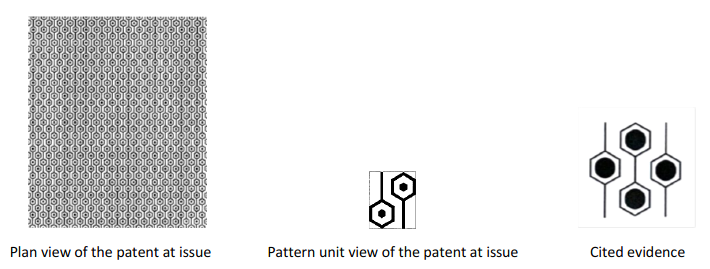 |
The Plaintiff asserted that the scope of protection of the patent at issue should be defined by the “plan view” rather than the “pattern unit view”, and that the IPO apparently erred in comparing the pattern of the cited evidence with the pattern unit view of the patent at issue, which was inconsistent with the principle that patentability of a design should be assessed based on its overall visual impression. The Plaintiff further pointed out that the pattern of the cited evidence differs from the design as claimed in the patent at issue in several respects:
First, the pattern unit view of the patent at issue presents two identical hexagonal patterns, each with a line segment, combined in a left-right inverted and offset manner, whereas the cited evidence as a whole presents four symmetrical hexagonal patterns arranged in a rhombus configuration.
Second, the design as claimed in the patent at issue features a hexagonal pattern with a line segment connected to one end, while the cited evidence consists of a configuration wherein line segments extend from the opposite ends of the two lateral hexagonal frames respectively, with a single line segment connecting the two hexagonal frames in the center.
Third, the design as claimed in the patent at issue employs a solid black hexagon identical in shape to the outer hexagonal frame, showing relatively large difference in proportion between the inner and outer hexagons, whereas the cited evidence features a solid circle filled inside the hexagonal frame with a closely matching proportion.
The Plaintiff contended that, if the pattern of the cited evidence were to be modified, deformed, and then continuously extended, it would produce a visual effect distinctively different from that of the patent at issue; as such, the design as claimed in the patent at issue would not have been readily conceivable and indeed possesses creativity.
After reviewing the case, the IP Court held that when comparing the primary drawings of the cited evidence with the pattern unit view of the patent at issue, both share the features of “offset hexagon arrangement” and “line segments extending upward or downward from the vertices of the central diagonal of the hexagons”. Although there is a minor difference, where the interior of the hexagon in the cited evidence contains a “solid black circle” while the pattern unit view of the patent at issue features a “solid black hexagon”, and although the inner circles/hexagons and the line segments extending from the outer hexagon frames differ slightly in terms of proportion and position, the Court found that such differences were insufficient to create a distinctive visual effect on the overall design. The IP Court further held that the design claimed in the patent at issue merely adopts the pattern disclosed in the cited evidence through simple modifications, such as adjustments to line positions, spacing proportions, and internal geometric elements, followed by continuous repetition in the vertical and horizontal directions, and that from the perspective of the overall pattern arrangement, the design claimed in the patent at issue fails to produce a visual effect distinguishable from that generated by the overall arrangement of the cited evidence. Accordingly, the Court concluded that the patent at issue is devoid of creativity.
As for the Plaintiff's assertions, the IP Court stated that: (1) The design feature of the patent at issue lies solely in its single-side pattern; where a design is a continuous surface pattern, it should include a pattern unit view constituting that surface pattern design. Furthermore, according to the design description of the patent at issue stating that “by extending the unit continuously upward, downward, leftward, and rightward, the overall pattern forms a continuous surface design that exhibits regular, cyclical repletion within interlacing variations,” it is evident that the plan view of the patent at issue is a continuous surface pattern design developed by extending the pattern unit view continuously in all four directions. Therefore, comparing the evidence against the pattern unit view of the patent at issue, and subsequently deducing the plan view design from the pattern unit view, is entirely consistent with the assessment method set forth in the Substantive Examination Guideline for Design Patents. (2) Both the pattern unit view of the patent at issue and the pattern of the cited evidence disclose the design features of “two identical hexagons, each with a line segment, combined in a left-right inverted and offset manner” and “a hexagon with a line segment connected at one end”; accordingly, Differences 1 and 2 claimed by the Plaintiff do not exist. Regarding Difference 3 alleged by the Plaintiff, the patent at issue employs a solid black hexagon identical in shape to the outer hexagon frame, with a relatively large difference in proportion between the two, whereas the cited evidence employs a solid black circle filled inside the hexagonal frame with a closely matching proportion; hence, the difference between the two lies merely in a simple alteration of the geometric pattern inside the hexagonal frame and a simple modification of the line thickness and proportional position of the outer frame. Such simple modifications (i.e., slightly changing geometric shapes or proportional position) are insufficient to create a distinct visual effect on the overall design of the patent at issue. Consequently, the Plaintiff's allegation are not untenable.
It is manifest from the foregoing that a pattern unit view does more than just define the applied-for design and serve as part of the essential drawings for full disclosure of a continuous surface pattern design. Because the pattern unit view depicts the specific characteristics of the repeating unit from which the overall surface pattern is developed through extension in the up-down and left-right directions, it may also serve as the standard unit for comparison in evaluating creativity. Given this, the pattern unit view can be regarded as one of the most important drawings in determining whether a continuous surface pattern design is eligible for patent protection. On the other hand, the Court also endorsed the approach of first comparing the pattern unit views and then deducing the continuous surface pattern design therefrom. Accordingly, when evaluating the patentability of a continuous surface pattern design, whether the design configuration of its pattern unit view is distinguishable from the prior art and produces a distinctive visual effect is critically important. This configuration may directly influence the visual effect of the continuous surface design developed through continuous extension in all four directions, and is thus worth careful consideration during design pattern development.