Process claims are among the important tools used to obtain patent protection for an invention. The IP & Commercial Court’s recent judgment (Civil Judgment 114 Min-Zhuan-Su-Zi No. 15, December 2025), which concerns the determination of infringement for anti-cancer drugs, provides an excellent example regarding the interpretation of relative terminology related to the core of a patented technology and the scope of process patent rights in patent infringement.
The plaintiff in this judgment is a brand drug manufacturer who obtained drug approval No. 027490 for the drug Carfilzomib (hereinafter referred to as "Drug A") and conducted patent linkage on the Taiwan patent linkage platform to link said drug approval to the patent in suit, TWI603737. The defendant, who is a generic drug manufacturer, applied for a generic drug approval for the plaintiff’s drug and asserted Paragraph 4, claiming that the linked patent is invalid or that the generic drug does not infringe upon the linked patent.
The core issue in this case is whether the defendant's generic drug infringes process claim 1 of the patent in suit and whether its product falls within the product-by-process claim 23 of the patent in suit.
I. Technical Core of Patent Claim: Why "Low Chloride" is Needed?
Claim 1 of the patent in suit relates to a method for preparing a low-chloride pharmaceutical composition, the method comprising:
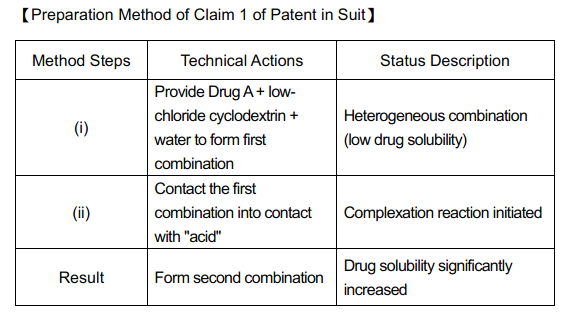
(i) providing a first combination, the first combination comprising: (a) a compound with an epoxide-containing chemical structure (i.e., Drug A) or a pharmaceutically acceptable salt thereof; (b) a low-chloride cyclodextrin ("CD"); and (c) water; wherein the first combination is heterogeneous and the solubility of the compound or salt in the first combination is low; and
(ii) contacting the first combination with an acid to form a second combination, wherein the solubility of the compound in the second combination is higher than the solubility of the compound in the first combination.
Another independent claim, Claim 23, is a product-by-process claim, namely a pharmaceutical composition prepared by the method of claim 1.
The technical core of this patented technology mainly lies in "low chloride". Why is low chloride necessary? The aforementioned Drug A is a peptide proteasome inhibitor, and the epoxide in its structure is highly sensitive to environmental conditions. It is discovered by the patent in suit that if an excess of chloride ions exists in the preparation environment, it will trigger a nucleophilic attack, producing "chlorohydrin adducts (i.e., chlorohydrin degradation product (CDP))," which the FDA regards as genotoxic impurities. To reduce genotoxic impurities and improve drug stability, the core technology of the patent in suit lies in using "low-chloride cyclodextrin" and increasing drug solubility to an administrable level through specific complexation steps.
II. Interpretation of Low-Chloride Numerical Range
During litigation, the two parties disputed the meaning of "low chloride" in the term "low-chloride cyclodextrin" in claim 1. Since "low" is a relative adjective, the court provided a precise numerical definition for this term based on intrinsic evidence and prosecution history:
- Intrinsic Evidence: The court pointed out that "low" is a relative adjective and that the specification must be consulted to clarify the scope. Table 3 of the specification shows that although a chloride content of 0.05% (w/v) still produces CDP, compared to a chloride content of 0.2%, the concentration of the produced CDP is an "acceptably low concentration."
- Prosecution History Estoppel: During prosecution of the patent in suit, to overcome a rejection for lack of inventive step, the patentee explicitly stated in a response that "the 'low chloride' defined in this case refers to a chloride ion content less than or equal to 0.05%."
- Final Interpretation: The court interpreted "low-chloride cyclodextrin" as "a cyclodextrin having sodium chloride less than or equal to 0.05% w/w".
III. Process Comparison: Patented Technology vs. Preparation Method for Accused Infringing Drug
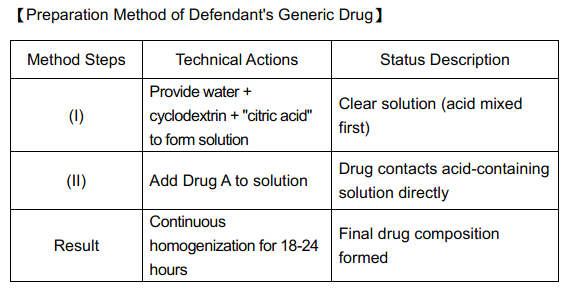
The defendant (generic drug manufacturer) asserted that its process differs from the patent in suit in terms of the order of steps. To facilitate understanding, the preparation process as claimed in the patent in suit and the preparation process used by the accused infringing drug are explained below:
Based on the control specifications for the generic drug in the drug registration process, the court determined that the cyclodextrin used by the defendant has a sodium chloride content of <0.03% and is classified as low-chloride cyclodextrin.
IV. Infringement Determination:
1. The defendant's method does not constitute literal infringement of the method claim 1.
In step (I) of the defendant's process, the cyclodextrin is mixed with acid (i.e., "citric acid"), but Drug A is not added; therefore, step (I) of the defendant's method is not literally read on by step (i) "providing a first combination, the first combination comprising Drug A, low-chloride cyclodextrin, and water" as defined in claim 1 of the patent in suit. However, in step (II) of defendant's process, after Drug A is added, the recitation of step (ii) of the patent in suit would be met, which reads putting the first combination (containing Drug A) into contact with acid to form the second combination. Therefore, the court determined that after Drug A is added, the step was literally read on by step (ii) of the claim. Since the defendant's process cannot be literally read on by step (i) of the claim, it does not constitute literal infringement of claim 1.
2. The accused process constitutes infringement of the process claim under the doctrine of equivalents.
The court then determined that the only difference between the defendant's process and the method of the patent in suit lies in the timing of the addition of Drug A. The court applied the "Tripartite Test" and the "Insubstantial Difference Test" to determine whether the accused process constitutes infringement under the doctrine of equivalents.
"Tripartite Test":
● Way is substantially the same:
The difference between the processes of the plaintiff and the defendant lies only in the timing of the addition of Drug A. Both use low-chloride cyclodextrin to avoid the degradation of Drug A and the generation of potential genotoxic impurities to improve stability. The difference in the timing of the addition does not affect the function and result of using low-chloride cyclodextrin. The actual complexation reaction time in the method of the generic drug is equivalent to the complexation reaction time in the patented method which lasts from several hours to one day. Therefore, it is evident that this change in the order of steps is a "simple change" and is "obvious to those skilled in the art", and the defendant’s generic drug is produced in substantially the same way as the patented technology.
● Function is substantially the same:
Both processes use cyclodextrin complexation to improve the solubility of Drug A and minimize CDP generation.
● Result is substantially the same:
Both processes ultimately obtain a stable and highly soluble low-chloride pharmaceutical composition.
"Insubstantial Difference Test":
Most of the undissolved Drug A in step (i) of claim 1 of the patent in suit needs to contact acid before being converted into dissolved form to participate in the complexation reaction. Therefore, regardless of the timing of the addition of Drug A, the complexation reactions of both processes mainly occur in the simultaneous presence of Drug A, water, low-chloride cyclodextrin, and acid. The reaction completion times are also equivalent (patent in suit: several hours to one day; generic drug: 18 to 24 hours). Thus, even if there is a difference in the timing of the addition of Drug A, the difference is clearly insubstantial.
Based on the above reasons, the court determined that the defendant's process constitutes infringement under the doctrine of equivalents.
3. The defendant's product constitutes literal infringement of the product-by-process (PBP) claim
Regarding claim 23 of the patent in suit, which is a product-by-process claim, the court considered the defendant’s product to be the same as the product defined by the PBP claim based on the following principles:
- According to the "Patent Infringement Assessment Guidelines," promulgated in 2016, product-by-process (PBP) claims are generally limited only to the product prepared by the claimed process. However, if at the time of filing of the patent application, it is difficult or infeasible to define the technical features of the invention other than using the process (such as with structure or characteristics), making it necessary to define the product per se only by the process (i.e., PBP claims), then the claims would cover all products possessing the "same structure or characteristics" as said product.
- In the patent in suit, the "low CDP and high stability" characteristics of the pharmaceutical composition were extremely difficult to be defined purely by chemical structure, making it necessary to define the product by its process.
- Although the defendant's generic drug adopts a different order of steps in its process, it has been tested to possess the same low chloride content (< 0.03%) and high stability, which are fully consistent with the characteristics of the product of the patent in suit. Therefore, the defendant's generic drug falls within the scope of the product-by-process claim and constitutes literal infringement of the PBP claim 23 of the patent in suit.
V. Conclusion and Practical Insights
This judgment establishes an important legal foundation for process patents:
- In chemical or pharmaceutical processes, if a "change in the order of steps" does not affect the substance of the core chemical reaction, the court will ensure the substantial protection of patent rights through the doctrine of equivalents .
- Product-by-process (PBP) claims may be given a broad scope covering "products with the same characteristics", if the product involved is considered difficult or infeasible to be defined by structure or properties.