According to the Guidelines for Determining Patent Infringement adopted by the Taiwan Intellectual Property Office, the determination of whether the overall appearance of an accused product is identical with or similar to that of a patented design shall be made from the perspective of an ordinary consumer purchasing the product, applying the principle of “overall observation and comprehensive judgment.” The determination considers the similarities and differences of each ornamental feature and the role each of ornamental features plays in the overall visual impression implanted on ordinary consumers, with emphasis placed on “parts or features that are likely to attract the attention of an ordinary consumer,” including “ornamental features that are significantly different from prior art” and “parts that are readily visible during normal use.” These, in combination with the other features, constitute an integrated overall visual impression, which is then used to determine whether the differences between two designs are sufficient to affect the overall visual impression of the designs.
To put it another way, whether two designs are similar in appearance focuses on the parts or features that are likely to attract the attention of consumers, accompanied by the other features to form an integrated overall visual impression. The visual differences are then assessed to determine whether they would cause confusion on the part of ordinary consumers. Accordingly, when the other features of two designs exhibit only slight differences, the parts or features likely to attract attention of ordinary consumers will be a decisive factor in the visual distinction assessment. In practice, what constitutes a “key” visually prominent feature can be gleaned from a recent design patent infringement case adjudicated by the Intellectual Property and Commercial Court (hereinafter referred to as the “IPC Court). Meanwhile, the Judge, in this case, expressed his opinion on whether patterns resembling those found in nature or on animals can constitute ornamental features eligible for patent protection.
The design patent at issue pertains to a “spray nozzle handle.” In terms of appearance, it comprises a handle body that extends vertically in a curved columnar shape, integrally formed with an outlet and an inlet respectively located at two ends of the handle body. The distinguishing ornamental features of the design lies in that, as shown in the perspective view and the left side view, the handle body is decorated with a plurality of longer and shorter grooves in a curved configuration. On the front side of the handle body, a shorter groove is arranged between every two longer grooves, thereby defining a plurality of ornamental segments. These ornamental segments extend and converge from the front side toward the central rear side of the handle body, presenting an outstanding visual effect resembling leopard spots or zebra stripes, as disclosed in the “description of design” section in the drawings of the design patent at issue.
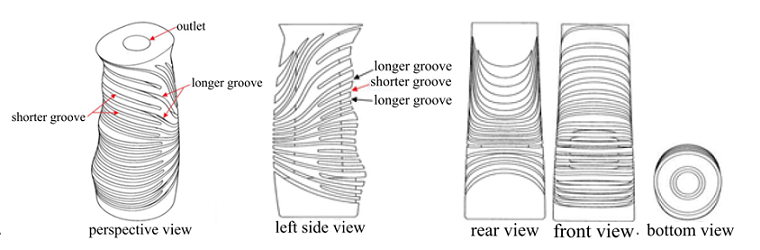 |
The accused product is an 8-pattern multi-purpose spray nozzle. The appearance of its handle includes a handle body that extends vertically in a curved columnar shape. As observed from the perspective view and the left side view, the handle body is decorated with a plurality of longer and shorter grooves in a curved configuration. On the front side of the handle body, a shorter groove is arranged between every two longer grooves, thereby defining a plurality of ornamental segments. As seen from the rear view, these ornamental segments extend and converge from the front side toward the central rear side of the handle body, presenting an overall visual effect resembling leopard spots or zebra stripes.
The IPC Court held that, when comparing the accused product with the design patent at issue, one may notice that they share the following features:
- A handle body extends vertically in a curved columnar shape;
- on the front side of the handle body, a shorter groove is arranged between every two longer grooves, thereby defining a plurality of ornamental segments;
- the ornamental segments extend and converge from the front side toward the central rear side of the handle body; and
- the ornamental segments constitute an image resembling leopard spots or zebra stripes.
Although there is a difference in the number of arcuate protrusions on the front side of the handle body—three in the patented design and four in the accused product—such minor variation, from the perspective of an ordinary consumer, is insufficient to alter the overall visual impression when assessed based on the principle of overall observation and comprehensive judgment. The overall appearance of the accused product and that of the design patent at issue are substantially similar. In other words, the accused product encompasses almost all the ornamental features of the patent at issue and creates a visual impression likely to bring about confusion with the patented design.
The defendant argued that the transverse grooves arranged on the handle of the design patent at issue are intended to increase friction between the spray nozzle and the user's palm so as to prevent slippage during use, and such transverse groove design would have been easily conceived by a person having ordinary skill in the art based on prior art before the filing date. The defendant asserted, moreover, that the design patent at issue merely applies a mimetic adaptation of patterns found in nature, such as leopard or zebra markings, to a common handle design with transverse grooves. Apparently, the design patent at issue was achieved by way of simple design techniques such as transforming, substitution, or combination of prior art, and therefore lacks creativity. In support of these claims, the defendant submitted evidence, i.e. Design Patent No. D123935 allegedly disclosing similar alternating arrangement of longer and shorter grooves.
In response to the foregoing defense, the IPC Court held that the cited evidence did not disclose a three-dimensional pattern composed of alternating longer and shorter grooves forming a plurality of recessed ornamental segments, as disclosed in the design patent at issue. The IPC Court also found that such a three-dimensional pattern is not merely a direct imitation or straightforward application of natural animal markings, such as leopard or zebra patterns, nor is it the result of a simple substitution or combination of prior art through routine design techniques. Rather, the primary ornamental feature of the design at issue, namely, the “alternating arrangement of longer and shorter grooves” was achieved through modification and reconstruction, producing a distinctive overall visual effect. The difference of the design patent at issue and the cited evidence is apparent, and the design patent at issue cannot be regarded as a design easily achieved. Therefore, the defendant's assertion that the design patent at issue was merely derived from prior art by means of imitation, adaptation, substitution, or combination through simple design methods is untenable, concluded the IPC Court.
In this case, the design and arrangement of the alternating longer and shorter grooves in the patented design were deemed visually distinct over the prior art. Furthermore, since these features are located in “areas readily visible during normal use,” they are likely to attract the attention of ordinary consumers and constitute key factors influencing the overall visual impression. Although the other portions of the design may exhibit different features, as their relative visual weight is lower, they are less likely to significantly alter the overall impression of the design. On this score, designers of related products should be aware that, in the course of improvement or creation, if modifications or newly created designs made to the portions likely to draw the attention of ordinary consumers fail to generate a differing overall visual impression from that of the prior art, there remains a risk that such designs may either be unpatentable or fall within the risk of design patent infringement.
On a final note, it is noteworthy that natural animal patterns may qualify as protectable subject matter under the Patent Act so long as they are not directly imitated, transformed, substituted, or combined, but are instead transformed through modification and reconstruction in a manner that produces a distinctive visual effect in the overall appearance.