According to Article 30.1.10 of Taiwan’s Trademark Act, a trademark shall be unregistrable if it is identical with or similar to another party’s trademark earlier filed or registered in respect of the same or similar goods or services, and is likely to bring about confusion or misidentification among relevant consumers. The term "likely to bring about confusion or misidentification among consumers" refers to a trademark which may potentially cause consumers confusion or misidentification regarding the source of the goods it represents or the entity producing them. In other words, “Likelihood of confusion or misidentification” may arise if the impression given by a trademark may lead consumers to mistakenly assume that goods from different sources belong to the same series of products or that there is a business relationship, such as affiliation, licensing, franchising, or other similar connections, between the users of two trademarks.
“Whether two trademarks are similar” and “the degree of their similarity” are important factors in determining the likelihood of confusion or misidentification. According to the “Examination Guidelines for Likelihood of Confusion” published by the Taiwan Intellectual Property Office (TIPO), the issue regarding whether a trademark constitutes similarity to another trademark should, in principle, be assessed based on the print of the trademark as applied for. In addition, evaluation should be conducted from the overall appearance, the pronunciation, as well as the concept of two trademarks to determine whether they have reached a level of similarity that could lead to consumers confusion or misidentification. As to the determination of whether the presence of certain parts in a trademark affects or enhances its distinctiveness over another trademark, such parts must be examined to ensure a correct overall assessment. The mere existence of identical or similar parts in two trademarks does not necessarily mean that the trademarks are highly similar.
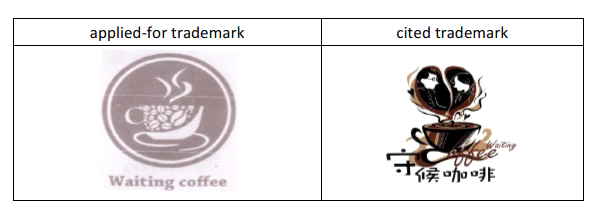
The Intellectual Property and Commercial Court (IPC Court) is generally inclined to support the viewpoints of the TIPO regarding the assessment of similarity of trademarks as highlighted in the “Examination Guidelines for Likelihood of Confusion.” However, this practice was apparently not followed when the IPC Court rendered a Ruling on January 15, 2025 on an administrative litigation case. In this case, an entity filed for registration of a trademark “Waiting Coffee and Design” (shown below) in respect of “coffee, coffee beverages, and related goods.” During the prosecution of the trademark application, the TIPO adduced the trademark "守候咖啡 Waiting Coffee and Design" (shown below) registered in respect of “coffee beverages, coffee beans” etc. in Class 30 as a citation bar (hereinafter referred to as the cited trademark.) In view of this, the applied-for trademark was rejected for registration under Article 30.1.10 of the Trademark Act.
Dissatisfied with the Office Action issued by the TIPO, the applicant filed an appeal with the Board of Appeals. Unfortunately, the appeal was dismissed for the reasons that the two parties’ trademarks are highly similar. The applicant then filed a petition for administrative litigation with the IPC Court without hesitation. After a period of examination, the IPC Court reached a conclusion totally different from the TIPO and the Board of Appeals. It ruled that that the two trademarks are not similar.
During examination, the TIPO compared the print of the applied-for trademark with that of the cited trademark and found that they share the English wording, “Waiting Coffee”, as their respective recognizable components. Although the two trademarks respectively incorporate additional device elements or Chinese characters, these elements do not alter the overall impression implanted in lay consumers that the key identifiable portion of both trademarks is “Waiting Coffee.”
Due to the high similarity in appearance, concept, and pronunciation, the TIPO estimated that an ordinary consumer, when purchasing goods by exercising a general level of attention, would mistakenly assume that the two parties’ products originate from the same source or, related sources. As a result, the two trademarks were deemed similar to a significant degree and their co-existence may bring about a likelihood of confusion or misidentification.
The Board of Appeals agreed with the TIPO’s assessment and further explained that both trademarks prominently feature the “Waiting Coffee" wording as their respective primary elements for consumer identification. Additionally, both trademarks incorporate a “coffee cup design” and convey the meaning of "waiting for coffee" (守候咖啡). Given their overall resemblance in appearance, pronunciation, and conceptual impression, an ordinary consumer - when observing the trademarks separately at different times and locations, or when encountering them sequentially in the market - may easily associate them as identical trademarks or trademarks belonging to the same brand series. Thus, there would arose a likelihood of confusion among consumers if the two trademarks with a “high degree of similarity” were allowed to co-exist in the market.
The IPC Court had a divided point of view nevertheless. It found that the design portion, as well as the overall appearance of the two trademarks are significantly different. While both trademarks contain the same English wording, “Waiting Coffee" or "Coffee Waiting", the "Waiting Coffee" wording in the applied-for trademark is placed below a visible circular coffee cup design and is not prominent. Similarly, the "Coffee Waiting" wording in the cited trademark is closely integrated with a coffee cup design in overlapping shades of black and brown, making it not particularly conspicuous. In addition, the cited trademark features the Chinese characters "守候咖啡", which are larger in font size and are more noticeable for pronunciation and recognition. Considering the overall appearance of the two trademarks, the IPC Court found that an ordinary consumer - when making a purchase by exercising general attention - is unlikely to mistakenly assume that the two trademarks originate from the same or related source(s). Consequently, the similarity between the trademarks was deemed to be low.
Furthermore, the IPC Court criticized that the TIPO had overlooked the aforementioned differences in the overall appearance of the trademarks. In other words, “ a high degree of similarity” that the TIPO found was based solely on the shared English wording and the general design concept of a steaming coffee cup, which violated the principle of assessing trademarks on the basis of the overall impression that may convey to lay consumers. Therefore, the IPC Court considered the TIPO’s determination of high similarity to be inappropriate and not tenable.
As the applicant did not file an appeal against the Ruling by the IPC Court, the trademark application concerned is currently undergoing re-consideration before the TIPO.
The IPC Court’s Ruling emphasizes the widely accepted practice that the overall appearance of a trademark is a crucial factor in determining trademark similarity. On this score, even if the pronunciation or conceptual meaning of two trademarks is identical, the two trademarks cannot prematurely be considered similar if they exhibit totally different overall visual appearances and are readily distinguishable from the consumer’s perspective.