The Taiwan Intellectual Property and Commercial Court (IPC Court) recently rendered its Judgment in Case No. 114-Shang-Yi-4, addressing the boundary between trademark infringement and descriptive fair use. The IPC Court upheld the first-instance acquittal of the legal representative of MAMOSY INTERNATIONAL CO., LTD. (MAMOSY) in a criminal trademark infringement case brought by ISG Wellness & Beauty Co., Ltd. (ISG). The Court held that MAMOSY's use of “BIO✙SKIN” on facial mask packaging constituted descriptive use of the characteristics and functions of the goods, rather than trademark use. Accordingly, such use fell outside the scope of the exclusive rights conferred by ISG's trademark registration.
Case Background
ISG owned Taiwan Trademark Registration No. 01802917 for “BIOSKIN,” covering cosmetics, facial masks, skincare products, and related goods. MAMOSY marketed facial masks bearing the sign “BIO✙SKIN” through its website and several major e-commerce platforms.
ISG alleged that “BIO✙SKIN” was confusingly similar to its registered “BIOSKIN” mark and constituted criminal trademark infringement. The first-instance court acquitted MAMOSY's legal representative. ISG appealed, but the IPC Court dismissed the appeal and upheld the acquittal.
The IPC Court's Analysis: Did the Use of “BIO✙SKIN” Constitute Descriptive Fair Use under Article 36.1.1?
Under Article 36.1.1 of the Taiwan Trademark Act, a third party may, in good faith and in accordance with honest commercial practices, use wordings that describe the name, quality, nature, characteristics, functions, or other attributes of its own goods, provided that such wordings are not used in trademark sense.
Although the IPC Court found “BIO✙SKIN” to be similar to ISG's “BIOSKIN” mark, the Court went on to examine whether MAMOSY's use constituted trademark use or fair use. The Court distinguished between two forms of fair use: descriptive fair use, in which a sign is used to describe the characteristics or attributes of the user's own goods, and nominative fair use, in which another party's trademark is used to identify that party's goods or services. The present case concerned descriptive fair use.
Accordingly, rather than determining the issue solely by comparing “BIO✙SKIN” with “BIOSKIN” in isolation, the IPC Court examined how “BIO✙SKIN” was actually presented and perceived in the marketplace, including its placement on the product packaging and its use in MAMOSY's marketing materials.
1. Overall Presentation of the Product Packaging
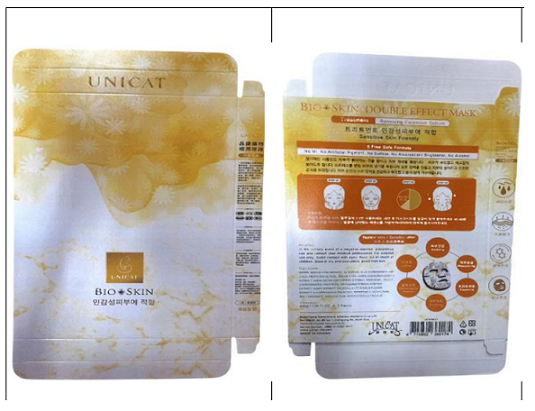
The Court first examined the overall appearance and presentation of the packaging, While MAMOSY's trademark 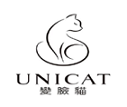 under Reg. No. 02361969 was displayed on the front of the packaging box, its other mark
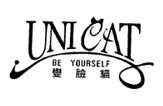 under Reg. No. 01664754 appeared on the back. The manner in which these marks were displayed further demonstrated that the facial mask products were marketed and sold under the aforementioned two registered trademarks.
The cat device and the word “UNICAT” were prominently displayed above “BIO✙SKIN” and occupied the most conspicuous portion of the package. The word “UNICAT” was also repeatedly displayed on the front, top, and side of the packaging. In addition, the back of the package identified MAMOSY and provided its company information.
Based on the overall presentation, the IPC Court accepted MAMOSY's argument that “UNICAT,” rather than “BIO✙SKIN,” functioned as the source identifier for the products.
Product packaging (front and back)
|
Source: IPC Court Judgment No. 114-Shang-Yi-4 (Apr. 30, 2025)
|
2. Actual Use in Online Marketing
The IPC Court next examined how the products were identified and promoted online. MAMOSY consistently referred to the products as “UNICAT” or “UNICAT 變臉貓” products on its website and major e-commerce platforms.
Importantly, the marketing materials did not refer to ISG's “BIOSKIN” trademark or suggest any commercial connection or association with ISG. This further supported the conclusion that consumers would not perceive “BIO✙SKIN” as indicating the commercial origin of the products.
3. Ordinary Meaning and Industry Usage
The Court also considered the ordinary meaning of the individual components of “BIO✙SKIN” and their usage in the relevant industry. While “SKIN” is an ordinary English word meaning skin, the Court found that “BIO” was commonly used in the skincare and biotechnology-related fields to convey biological or biotechnology-related concepts.
The Court further considered the Korean wordings appearing on the packaging, which indicated that the product was suitable for sensitive skin. Taking these elements together, the IPC Court found that “BIO✙SKIN” conveyed information concerning the materials, characteristics, and effects of the facial masks, rather than functioning as an indication of commercial origin.
The Court therefore concluded that MAMOSY's use of “BIO✙SKIN” constituted descriptive fair use under Article 36.1.1 of the Taiwan Trademark Act.
Takeaways
This decision illustrates that similarity between two signs does not, by itself, establish trademark infringement. Even where a challenged sign is found to be similar to a registered trademark, the court may still need to determine whether the sign is being used as a trademark or merely used to describe the characteristics, functions, or other attributes of the goods.
The decision also highlights the importance of establishing trademark use in enforcement proceedings involving descriptive or commonly used terms. For trademark owners, this case serves as a reminder that demonstrating similarity between the disputed sign and the registered mark may not be sufficient where the challenged use may reasonably be perceived as descriptive. In determining whether consumers would perceive a disputed expression as a source identifier, courts may consider the overall presentation of the packaging, the prominence of house marks, product naming, online marketing materials, and the context in which the disputed expression is used, rather than assessing the disputed expression in isolation.