To give applicants greater flexibility in using the deferred examination system and support applicants’ establishment of an intended patent portfolio and/or patent commercialization, Taiwan has announced and put into effect an amendment to the regulations on Examination Deferral on January 1, 2026.
In the amendment, the applicable periods that invention and design patent applications may request for deferred examination were extended. That is, for invention patent applications, the period for requesting deferred examination was extended from three years to five years, as calculated from the filing date. And for design patent applications, the corresponding period was extended from one year to two years. The amendment also stipulated that a request for deferred examination may only be filed once for each application. In addition, the deferral does not apply to the event in which a third party has requested for substantive examination, or to applications which have been placed under an accelerated examination procedure, such as the Patent Prosecution Highway (PPH).
Six months after the amendment took effect, statistical data presented by the Taiwan Intellectual Property Office (TIPO) at seminars in July and August 2026 indicate how the deferred examination system is currently being used.
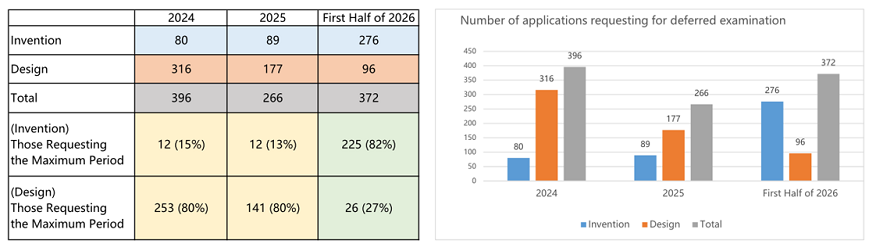
For invention patent applications, 80 and 89 applications requested deferred examination in 2024 and 2025, respectively. In both these years, 12 applications requested the full three-year deferral period, accounting for 15% and 13%, respectively. After the five-year deferral period became available on January 1, 2026, as many as 276 applications requested deferred examination within the first six months of 2026, of which 225 applications (82%) requested the full five-year deferral period, indicating a significant increase of applicants making full use of the newly available five-year period.
For design patent applications, there were 316, 117 and 96 applications that requested deferred examination in 2024, 2025 and the first half of 2026, respectively. The proportion of applications that requested the full available deferral period in 2024 and 2025 remained around 80%. In the first half of 2026, 26 applications requested the full available deferral period, i.e., two years.
When looking closer at the type of applications requesting for deferred examination, in 2024 and 2025, the IPC of the majority of the invention patent applications were H10D, H10F and H10J. In 2026, based on the statistics available through April rather than June, the top three classifications were H10N, H10D and H10W. These figures indicate that the requests for deferred substantive examination of invention patent applications were primarily concentrated in the H10 field, which relates to semiconductor technologies. For design patent applications, LOC Class 12-16, which relates to vehicle parts, was ranked first in all of the three years and had the largest number of applications.
The statistics for design patent applications indicate that the extension of the period from one year to two years appears to have not brought about a significant change in practice. In contrast, for invention patent applications, the extension of the maximum deferred examination period from three years to five years from the filing date resulted in substantially greater use of the deferral system. One possible reason is that both the maximum deferred examination period and the deadline for requesting substantive examination were the same before the amendment, i.e., three years from the filing date, which limits the practical benefits of deferring examination for invention patent applications. After the amendment, however, the deferred examination period was extended to five years from the filing date, which allowed applicants to make even more effective use of the deferred examination.